

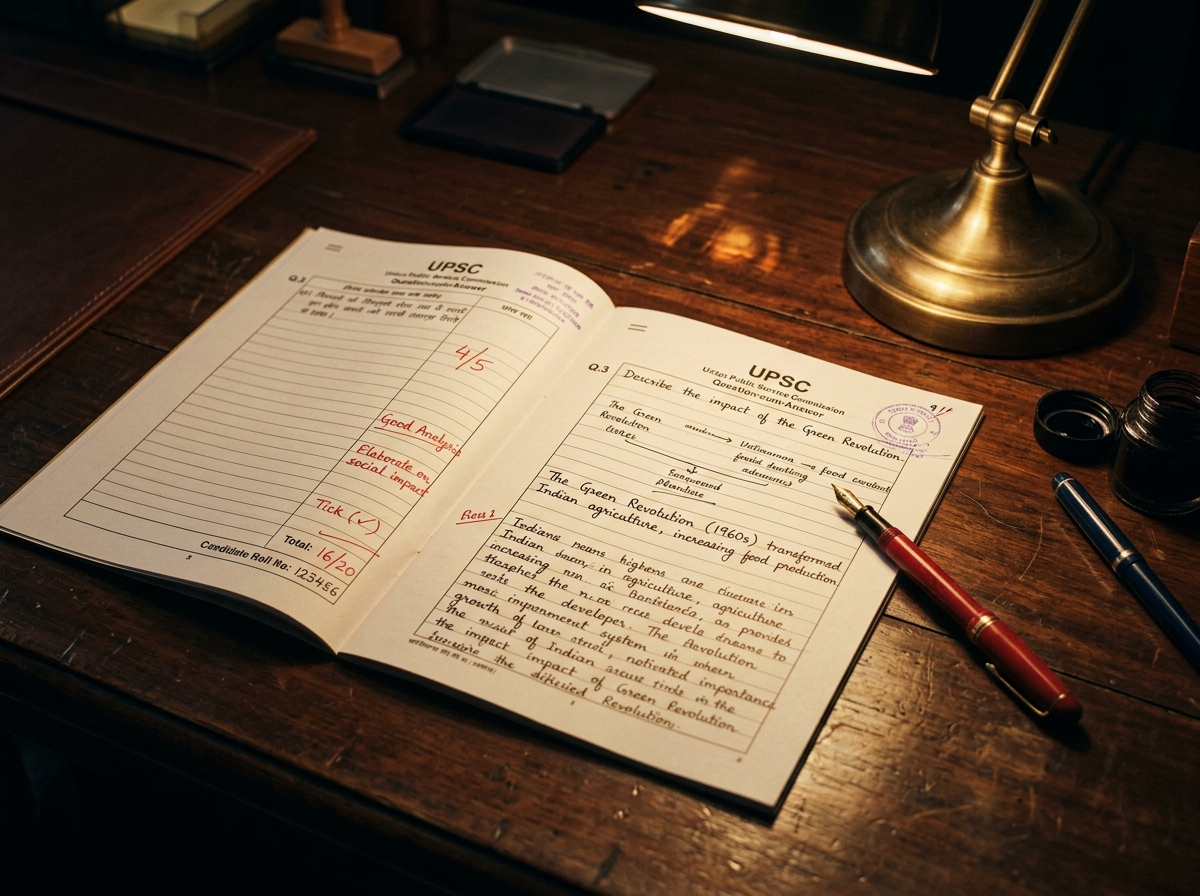
Mastering Mains Answer Writing: The Definitive Guide to UPSC CSE Practice, Copy Evaluation & Scoring
In the competitive landscape of the UPSC Civil Services Examination (CSE), mains answer writing is the decisive factor determining whether an aspirant secures a top rank or misses the final list. While the Prelims stage tests recognition under negative marking, the Mains examination demands articulation, multidimensional synthesis, speed, and analytical rigor. Every year, thousands of serious candidates master the UPSC syllabus from standard references, yet struggle to convert their knowledge into an impressive upsc mains answer writing copy within the strict 7-to-10-minute exam window.
To bridge this crucial gap, Cooked Mains offers India's most advanced, 100% free AI-powered ecosystem designed exclusively for upsc mains answer writing practice. By combining state-of-the-art multimodal vision with authentic UPSC examiner rubrics, Cooked Mains empowers self-study aspirants across the country to practice daily, upload their handwritten copies, and receive instant, objective, line-by-line feedback.
01
Cooked Mains Practice Framework • 5-Dimension Diagnostic Rubric
Cooked Mains Practice Framework • 5-Dimension Diagnostic Rubric
How Cooked Mains Evaluates a 10-Mark UPSC Answer Copy
Cooked Mains evaluates handwritten copies using a 5-dimension diagnostic framework calibrated to our scoring engine. The breakdown below demonstrates how a standard 10-mark question is evaluated across each scoring category. (Note: maximum marks scale by question type—such as 15 marks with 2.0 Intro, 7.0 Core Demand, 2.5 Value Addition, 1.5 Presentation, and 2.0 Conclusion—while this inspector illustrates the 10-mark model). Select any dimension below to inspect its scoring standard, evaluator perspective, sample annotated copy, and score booster tips:
Introduction & Conceptual Framing
Evaluates opening economy: framing the core concept, defining key operational terms, or establishing an authoritative data hook within 20–25 words without repeating the question verbatim.
Evaluators check whether the opening sentence defines the core issue or cites a relevant constitutional article/metric rather than merely rephrasing the prompt.
02
Interactive Answer Comparison • Candidate Copy vs. IAS Topper Model
Interactive Answer Comparison • Candidate Copy vs. IAS Topper Model
Before & After: Anatomy of an Unstructured Draft vs. a Model Revision
Illustrative comparison demonstrating common structural errors versus a high-scoring model revision on the same 10-mark prompt. Drag the divider handle or use the mode buttons to inspect sample examiner margin feedback and structural enhancements.
"Discuss the significance of the 73rd Constitutional Amendment Act in empowering Panchayati Raj Institutions. What are the persistent institutional bottlenecks that hinder effective local self-governance?"
The 73rd CAA (1992) institutionalized a 3-tier structure by inserting Part IX (Articles 243-243O) and the 11th Schedule (29 subjects), transforming representative democracy into participatory self-rule.
- Grassroots Deliberation: Empowered Gram Sabhas (Art 243A) as the deliberative foundation.
- Inclusive Mandate: Mandatory 33% reservation for women (Art 243D) and proportionate SC/ST representation.
- Fiscal Squeeze: Irregular constitution and ignored recommendations of State Finance Commissions (Art 243-I).
- Administrative Bypassing: Parallel parastatals (e.g. DRDAs) dilute panchayat executive authority.
- Societal Impediments: Sarpanch-Pati syndrome undermines substantive decision-making by women leaders.
Hypothetical scores illustrating the quality contrast between unstructured and structured practice drafts.
Separated into constitutional basis, 3F deficit, and roadmap.
Citing 2nd ARC (6th Report) on 3Fs & Sumit Bose Committee on PRI administrative capacity.
Structured schematic box enables clear, efficient evaluative scanning.
03
Daily Practice Protocol • The 3-Hour Simulation Guide
Daily Practice Protocol • The 3-Hour Simulation Guide
Building a Disciplined Routine: The 6-Stage Practice Loop
Writing 20 questions in 3 hours under UPSC exam hall pressure requires conditioned time management and consistent recall. Relying solely on occasional mock tests often leaves pacing unpracticed. This suggested 6-stage daily workflow offers a structured framework to make timed answer practice a regular habit:
Question Intake & Directive Verb Deconstruction
Dissecting the prompt before putting pen to paper.
Select 1 question from our Daily Target practice challenge (curated from The Hindu, Indian Express, PIB, and standard UPSC themes). Spend the first 180 seconds actively dissecting the prompt: circle the directive verb (e.g. Discuss vs. Critically Analyze vs. Evaluate), count the implicit sub-demands, and jot down 3 core keywords in the margin.
Strictly closed-book. Do not consult notes or search the web before writing. Test active cognitive retrieval to simulate real exam-hall mental conditions.
Writing about the general topic rather than the specific directive. A prompt asking to "Critically Analyze" requires structural balance and counter-arguments, not a one-sided descriptive essay.
Timed Closed-Book Exam Simulation & Margin Discipline
Conditioning motor reflexes and speed under strict clock pressure.
Start an uninterrupted timer: exactly 7 minutes for 10-markers (150 words) or 10 minutes for 15-markers (250 words). Draft your response on standard UPSC-style ruled Question-cum-Answer Booklet (QCAB) paper with 2.5cm red left/right margins. Stop writing the exact moment the timer expires.
Respect the 2.5cm ruled margins strictly. Writing across margins disrupts visual scanning and invites negative penalty marks in UPSC evaluation.
Continuing to write past 7 minutes to finish a paragraph. In the actual examination, spending 9 minutes on question 1 guarantees leaving 2 to 3 full questions unwritten at the end.
Multimodal Vision OCR Ingestion & Boundary Detection
Zero-friction digitization of handwritten scripts and margin contours.
Snap a clean photograph of your handwritten QCAB answer page or upload a multi-page PDF. Cooked Mains' multimodal vision pipeline detects margin boundaries, transcribes cursive handwriting line-by-line, and verifies question-prompt alignment before diagnostic processing begins.
Upload immediately upon completion. Zero delay between writing and diagnostic inspection locks feedback while thoughts and framing are fresh in memory.
Faint pencil or low-contrast light. Use dark blue or black ink pens and photograph flat under good ambient lighting to ensure optimal OCR transcription.
Diagnostic 5-Dimension Rubric Scoring Audit
Objective criteria evaluation across Intro, Core Demand, Enrichment, Format, and Conclusion.
The evaluation engine conducts a comprehensive structural audit across 5 calibrated dimensions: (1) Introduction Context, (2) Core Demand Fulfillment, (3) Value Addition & Citations, (4) Presentation & Formatting, and (5) Conclusion & Synthesis. Each criteria receives an explicit diagnostic mark breakdown.
Evaluate individual dimensions rather than only the total mark. Pinpoint whether marks were lost due to weak factual backing, unstructured body paragraphs, or an abrupt conclusion.
Relying on subjective impressions like "needs improvement" without quantitative category breakdown. Criteria scoring identifies the exact structural deficiency.
Line-by-Line Examiner Red-Pen Margin Remark Synthesis
Concrete marginal prescriptions mapped to specific lines of your handwritten answer.
Review digital red-pen margin comments placed directly beside your handwriting. The feedback pinpoints monolithic text blocks that should have been separated, flags vague platitudes, and suggests specific constitutional articles, committee names, and schematic boxes.
Cross-examine each red margin remark against your actual sentence. Ask: "How could this 30-word sentence be converted into a concise point with an authoritative keyword?"
Reading feedback passively without noting mistakes. Keep an active log of recurring marginal warnings to prevent repeating the same structural habit in tomorrow's draft.
Model Answer Delta Comparison & Targeted 5-Minute Rewrite
Closing the gap between your draft and an exemplary model answer.
Compare your answer side-by-side with our structured Model Answer Blueprint. Record missed dimensions, committee names, and statistics in your personal error ledger. Spend 5 minutes rewriting the weakest paragraph or conclusion to solidify lasting retention.
Rewrite immediately. Studies on motor and cognitive learning demonstrate that redrafting within 10 minutes of diagnostic feedback produces significantly higher retention than passive reading.
Moving on to the next subject without rewriting. Evaluation without iterative revision repeats the exact same presentation errors on test day.
Ready to Start Today's Timed Answer Writing Session?
Upload your handwritten answer copy for instant line-by-line red-pen annotations, 5-dimension rubric scoring, and structured model answer feedback. Zero card required.
04
The Anatomy of a High-Scoring UPSC Mains Answer
The Anatomy of a High-Scoring UPSC Mains Answer
1 The Anatomy of a High-Scoring UPSC Mains Answer
Writing high-scoring answers in General Studies Papers (GS 1, GS 2, GS 3, GS 4) and the Essay paper requires a balance of substance, structure, and presentation. Evaluators examine hundreds of scripts daily; an answer that looks dense, unstructured, or generic receives average marks. To consistently score above the 50th percentile in mains answer writing upsc, every candidate must master three foundational structural pillars:
1. Contextual Introduction
Open with an immediate hook rather than generic preambles. High-scoring introductions deploy one of three proven formats:
- Constitutional Hook: Cite Articles (e.g., Art 21, 39A, 280), Landmark Judgments (Kesavananda, Puttaswamy).
- Data & Report Anchor: Quote official indices (NITI Aayog, NFHS-5, RBI, Economic Survey, IPCC AR6).
- Precise Definitional Hook: Define technical terms concisely with institutional clarity.
2. Multidimensional Body
Break down your core thesis into structured, symmetrical subheadings addressing all explicit and implicit demands of the question:
- PESTLE Framework: Cover Political, Economic, Social, Technological, Legal, and Environmental dimensions.
- Stakeholder Mapping: Delineate citizen, state, judicial, market, and marginalized community angles.
- Bullet & Underline Rhythm: Write crisp 1.5-line bullet points with bold keywords to facilitate rapid visual parsing.
3. Futuristic Conclusion
Never conclude with mere repetition of arguments. A civil servant's conclusion must project administrative vision, balance, and constitutional optimism:
- The 3W Formula: Way Forward + World/National Frameworks (Viksit Bharat @ 2047, SDG 2030, Net-Zero 2070).
- Committee Roadmaps: Cite Punchhi Commission, 2nd ARC, or parliamentary panel blueprints.
- Constitutional Morality: Reaffirm fundamental rights, fraternity, and equitable inclusive growth.
How to Deconstruct UPSC Question Directives Without Losing Marks
Misinterpreting the directive verb is the #1 reason candidates with solid knowledge end up scoring 3/10 instead of 6.5/10. Here is how examiners evaluate each key directive:
Explore all angles, pros and cons, context, and underlying causes. Conclude with a balanced summary.
Common Pitfall: Writing a one-sided essay without counter-arguments.
Break into components; assess strengths and fatal limitations with empirical data before giving a justified verdict.
Common Pitfall: Pure criticism without recognizing progressive achievements.
Make a complex idea crystal clear using facts, cause-and-effect reasoning, and contemporary Indian examples.
Common Pitfall: Abstract theoretical philosophical rambling without concrete illustrations.
Investigate facts with forensic rigor; dissect institutional bottlenecks, implementation gaps, and root causes.
Common Pitfall: Superficial narrative without institutional or statutory depth.
Measure real-world outcomes against intended statutory or policy objectives using quantitative KPI benchmarks.
Common Pitfall: Describing the scheme features instead of assessing its impact.
State your informed viewpoint on the proposition, backing every stance with statutory provisions and administrative facts.
Common Pitfall: Emotional or biased editorializing without policy grounding.
Visual Schematics & Space Economy: The 1.5-Mark Advantage
In a paper where 15,000 aspirants write similar textbook points, visual aids communicate mastery in seconds and relieve examiner fatigue. Integrating 1 to 2 micro-schematics per answer consistently yields an extra 1 to 1.5 marks:
Essential for Geography (Monsoon winds, resource belts), Internal Security (Red Corridor, border chokepoints), and Infrastructure corridors.
Perfect for multi-factor issues (Vicious cycle of poverty, climate vulnerability feedback loops, MSME bottlenecks).
Use 2-column or 3-column tables for Parliamentary vs Presidential systems, Direct vs Indirect taxes, or ethical options in Case Studies.
Respect the 2.5cm ruled margins strictly. Writing across margins invites negative penalty marks and disrupts scanner readability.
05
Frequently Asked Questions • Mains Answer Writing & Copy Diagnostics
Frequently Asked Questions • Mains Answer Writing & Copy Diagnostics
Frequently Asked Questions on UPSC Mains Answer Writing
Authoritative, practical guidance on how to start, practice, structure, and boost your UPSC Civil Services Mains answer writing scores.
How to write UPSC mains answer writing?
A high-scoring UPSC Mains answer adheres to the classical 3-part framework:
- Introduction (15–20%): Define the key term, state the constitutional context (Article/Act), or cite a relevant national report or index.
- Body (70–75%): Decode the directive (Discuss, Examine, Critically Analyze). Divide into multidimensional subheadings using the PESTLE approach (Political, Economic, Social, Technological, Legal, Environmental). Supplement with bullet points, flowcharts, and micro-diagrams.
- Conclusion (10–15%): Provide a forward-looking, solution-driven way forward aligned with constitutional morality, NITI Aayog guidelines, or the UN SDGs.
How to start mains answer writing as a beginner?
If you are new to Civil Services Mains answer writing:
- Build Foundation First: Finish basic NCERT readings and standard books for a subject so you have factual fodder before writing.
- Start with PYQs: Pick 1 simple static Previous Year Question daily (GS1 History or GS2 Polity) rather than complex opinion editorials.
- Ignore the Clock Initially: For the first 30 days, focus purely on question comprehension and structure rather than writing within 7 minutes.
- Get Line-by-Line Evaluation: Upload your handwritten script to Cooked Mains to catch structural flaws and margin errors instantly.
How to practice mains answer writing consistently?
Consistent practice builds muscle memory and exam stamina:
- Daily 2–3 Answers: Write 2 to 3 answers every day linked to current affairs and your static daily revision targets.
- Use Ruled UPSC QCAB Sheets: Always write on standard UPSC ruled answer sheets with 2.5cm side margins to master page layout and spatial economy.
- Strict Timers: Cap 10-markers (150 words, 2 pages) at 7 minutes, and 15-markers (250 words, 3 pages) at 11 minutes.
- The Rewrite Rule: Review your red-pen margin feedback on Cooked Mains and rewrite any answer scoring below 50% to internalize examiner corrections.
How to improve answer writing in UPSC mains?
Progressing from average scores towards competitive, top-bracket marks (consistently aiming for 5–6+ marks on a 10-marker) requires 4 disciplined levers:
- Micro-Heading Segmentation: Break multi-part questions into distinct subheadings so the evaluator can award marks for every segment.
- Authentic Value Addition: Cite official committees (2nd ARC, Sarkaria, Punchhi), Law Commission recommendations, economic survey facts, and Supreme Court rulings.
- Visual Presentations: Integrate quick hand-drawn India maps, flowcharts, circular cycle diagrams, and comparative two-column tables.
- Benchmarking Topper Rubrics: Compare your evaluations directly against Cooked Mains' topper-grade model rubrics to locate overlooked dimensions.
How to practice answer writing for IAS mains?
IAS Mains demands holistic coverage across 4 GS papers and Optional:
- Phase 1 (Micro-Syllabus): Answer writing aligned with weekly static targets across GS1, GS2, GS3, and GS4.
- Phase 2 (Sectional Tests): 10-question timed sets (1.5 hours) to build speed and transition between diverse subjects.
- Phase 3 (Full 3-Hour Simulation): Write 20 questions in a single 3-hour sitting twice a week in the final 90 days before Mains.
- Instant AI Diagnostics: Use Cooked Mains for prompt diagnostic feedback, handwriting margin checks, and identifying recurring presentation and structural gaps.
Which AI is best for UPSC answer writing?
Cooked Mains (cookedmains.com) is designed specifically as an AI practice and evaluation workspace for UPSC Mains answers:
- Handwritten Copy Vision: Unlike generic chatbots that only accept typed prompts, Cooked Mains processes handwritten camera photos or PDFs using multimodal vision.
- Structured Practice Rubrics: Calibrated across 5 diagnostic criteria: Introduction, Core Demand Fulfillment, Value Addition & Evidence, Presentation & Schematics, and Conclusion & Way Forward.
- Line-by-Line Red-Pen Marks: Provides line-by-line margin annotations directly on your copy within seconds.
- Daily Free Access: Grants 15 full copy evaluations every single day to all aspirants.
Can I prepare for UPSC for free?
Yes, absolutely. An aspirant can prepare effectively for the UPSC Civil Services Examination through self-study without expensive coaching institutes:
NCERT PDFs from official portals, PRS India, PIB, NITI Aayog Strategy documents, and Sansad TV discussions are freely available.
Cooked Mains provides 15 free handwritten copy evaluations every single day with rubric grades and model answers, enabling consistent practice without mandatory paid test series subscriptions.
Daily curated editorial Mains questions with GS syllabus mappings, model frameworks, and PYQs are available right on Cooked Mains.
Ready to Upgrade Your UPSC Mains Answer Writing?
Upload your handwritten answer copy now and experience instant red-pen evaluation with 15 free evaluations every day.
Built for Aspirants, Backed by Transparency
Dedicated resources, policies, and channels designed to keep your UPSC preparation secure, authentic, and supported.
About Us
Learn about our mission to democratize UPSC answer evaluation with 15 free daily copies and instant multimodal AI.
Contact Us
Submit questions, feedback, or bug reports. Our team reviews every message and responds within 24 hours.
Privacy Policy
How we protect your answer copies, locker history, and account data with zero third-party commercial selling.
Terms & Conditions
User guidelines, educational AI estimation disclaimers, and 15 free daily copies fair-use rules.
Independent Practice Disclaimer & Evaluator Integrity Notice
No Official UPSC Affiliation
Cooked Mains is an independent self-study platform. It is not affiliated with, endorsed, authorized, or sponsored by the Union Public Service Commission (UPSC) or any government ministry. Official examination standards and notifications are published solely by the UPSC at upsc.gov.in.
Simulated Practice Benchmarks
All rubric scores, marks deltas, and margin remarks are illustrative educational estimates for self-study feedback. They do not constitute official marks, percentile predictions, or guarantees of selection in the Civil Services Examination.
Calibrated AI Feedback
Evaluations use vision and language models calibrated against a 5-dimension academic rubric. Automated evaluations are designed to support self-guided practice and should be used alongside personal syllabus study and answer revision.